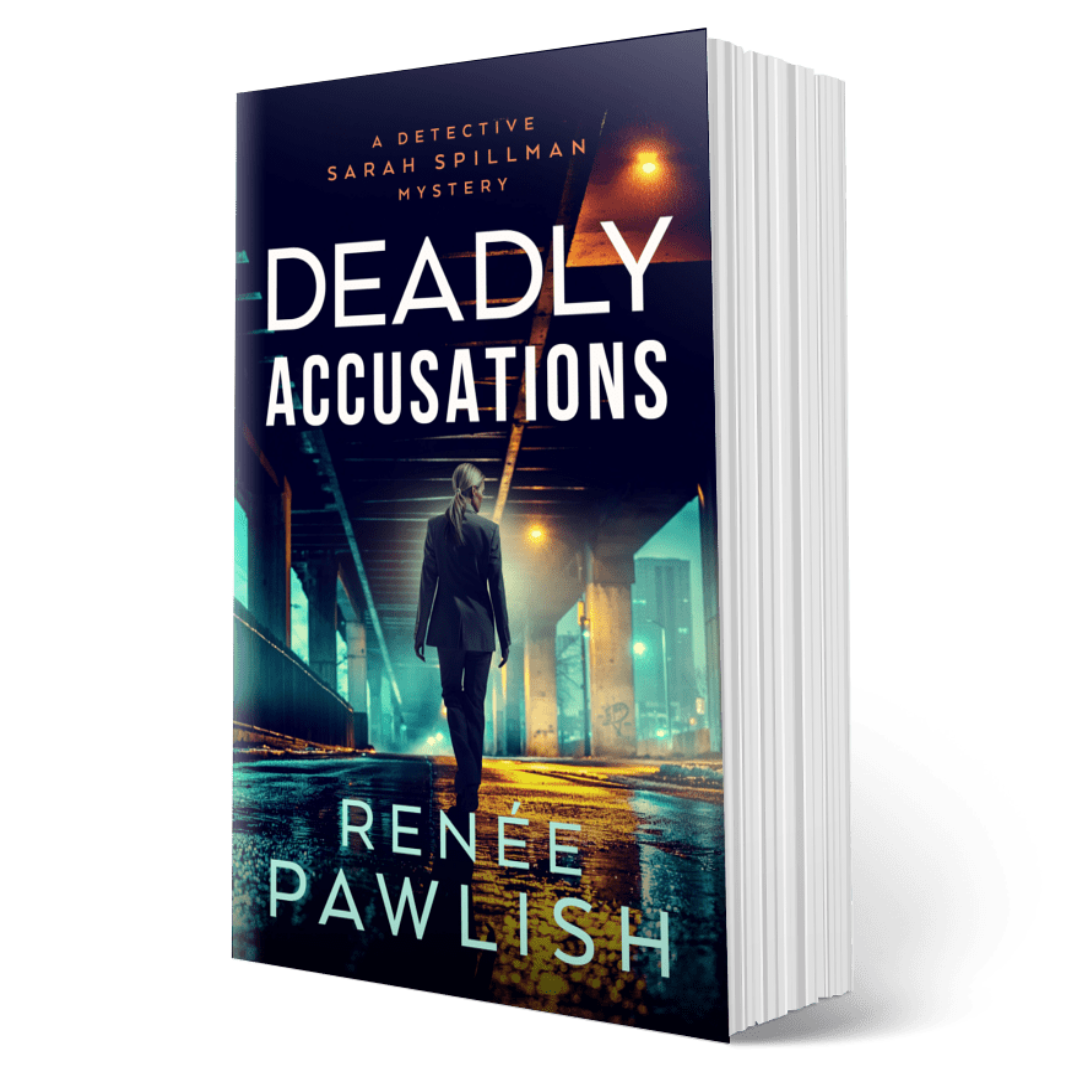
Deadly Accusations, Sarah Spillman Police Procedurals: Book 13
Original price was: $19.99.$14.99Current price is: $14.99.
Denver homicide detective Sarah Spillman has spent her career chasing the truth, but now everyone’s questioning her.
When a critical piece of evidence disappears from a murder investigation, suspicion falls on her, and she’s suspended from the force. In a department already under pressure, that’s enough to turn colleagues into skeptics and put her career in jeopardy.
But the missing evidence is only the beginning.
As the case twists in unexpected directions, Sarah is caught between what she knows and what others believe. The more she pushes for answers, the more dangerous things become, because whoever is manipulating the investigation isn’t just trying to protect a murderer.
With her badge stripped away and her reputation on the line, Sarah must uncover the truth before the accusations against her become the only story anyone believes.
Sample Chapter
Sarah – Wednesday, present day
I stood in Commander Calvin Rizzo’s office while he finished reading something on his desk. He didn’t look up right away. He never rushed a conversation he intended to control. The longer he kept his eyes on the paper, the longer I had to stand there and wait.
I kept my hands at my sides, not folded or in my pockets. Just loose, casual. There’s a difference between looking impatient and looking defensive, and I wasn’t giving him either.
Word had already spread that questions were being asked about my investigation. And when Rizzo had called me in moments before, one of my partners, Ernie Moore, had lifted his brows. My other partner, Roland “Spats” Youngfield, had gone quiet. No one says anything out loud, but everyone watches.
Rizzo turned a page, slowly enough to make a point without appearing theatrical. If this were about a routine case update, he would have said so. If it were about a commendation, he wouldn’t have made me wait. Which left the other possibilities.
I shifted my weight once, then forced myself to be still again. The silence wasn’t accidental. He was setting the tone before he ever spoke.
Finally, Rizzo set the paper down and lifted his eyes to mine. He stayed seated behind his desk and contemplated me. His tie was centered, the knot tight against his collar. Not a wrinkle anywhere on his suit. He always came to work prepared. Today felt no different.
He gestured to the chair across from him. “Sit down.”
“No.” I didn’t move. He leaned back, his hands flat on the desk. His broad shoulders filled the space behind it. I went on. “Tell me you don’t believe what you heard.”
His deep voice was devoid of emotion, and he didn’t rush his words. “The evidence was there. Now it isn’t. You checked it out and it’s not back.” There was something in his voice I couldn’t identify. Disappointment, maybe. Or something harder.
“I didn’t.” I knew my denial sounded lame.
“The logs don’t lie.”
“So prove I took it.”
“That’s not how it works.” He stared at me. “The allegation exists. The chain of custody is compromised.”
“In my investigation.”
“In your investigation.”
I clenched my teeth. “You’re suspending me over something you can’t even tie to me.”
“I’m placing you on administrative leave pending an investigation.” His tone didn’t waver. “That’s protocol.”
“Protocol doesn’t make it true.”
“No. But it makes it mandatory.”
I took a step closer to the desk. “You think I compromised my own homicide investigation?”
Rizzo held up a hand, palm out. “The flash drive and notebook are gone.”
“Those came from the victim’s apartment. I booked them myself.” My voice was even, but I could feel the heat rising in my chest. “I logged them and submitted them to property. I followed procedure.”
“They were there Monday.” He paused. “They weren’t there yesterday. You checked out the evidence and it’s not back.”
And now it was Wednesday. I stared at him, trying to process what he was saying. “What’s going on? Who discovered that?”
“You know I can’t discuss the source of the allegations.”
“Someone accused me of tampering with evidence in my own case?” I said. “And you won’t tell me who?”
He looked at me for a long moment, and something flickered in his eyes—regret, maybe, or frustration. But his voice stayed firm. “It’s done, Sarah.”
The use of my first name landed like a punch. Rizzo rarely called me anything but Spillman or Detective. I stood there, the silence long between us, the soft rush of air from the ceiling vent the only sound in the room.
Then he said, “I need your weapon.”
My hand moved instinctively to my hip, where my Glock was holstered. I didn’t say anything, only looked at him.
“Place it on the desk,” he said.
I drew the weapon slowly, my fingers wrapping around the grip. I knew its balance the way I knew my own stride. I’d carried this gun for years. I set it on the desk between us, the metal making a soft sound against the wood.
“Clear it,” Rizzo said.
I picked it up again, pressed the magazine release, and the magazine slid free with a metallic click. I drew the slide back, ejected the round from the chamber, and let it drop into my hand. I set the gun down again, then placed the magazine and bullet beside it.
Rizzo reached into a drawer and pulled out a clear evidence bag. He didn’t look at me as he picked up the gun, the magazine, and the loose round, placing each item carefully into the bag. He pressed the strip down, the plastic crackling under his fingers. Then he looked up at me.
“Your badge.”
I reached for my waistband, where my gold shield was clipped. My fingers hesitated for a second before I pulled it free. The metal felt heavier than it should have, cold in my palm. I stared at the engraved number and the Denver Police Department seal. Then I set it on the desk.
Rizzo picked it up and placed it into a second evidence bag. He sealed that one too, the sound of the adhesive louder this time, or maybe I was more aware of it. He stacked the two bags on the corner of his desk, then folded his hands in front of him.
“You’re relieved of investigative duties,” he said. His voice was formal now, reciting protocol. “Do not contact witnesses. Do not access department systems. You do not have access to evidence storage. Do not discuss the case with anyone except your attorney and Internal Affairs.”
“Ernie and Spats will continue it?” I asked.
“Yes.” He studied me, his hard face giving nothing away. “If you start poking around, I can’t protect you.”
“I understand.”
He watched me for several seconds, as if evaluating whether I actually meant it. Then he reached across his desk and slid a printed notice toward me. The Denver Police Department seal was printed at the top. I didn’t pick it up.
“Do you believe I did this?” I asked.
A muscle twitched near his temple. “I believe this needs to be investigated. Internal Affairs will contact you.”
I stared at him. He didn’t blink, didn’t look away. But he didn’t say anything else either. The silence was my dismissal. I took the paper, jammed it in my pocket, then turned and walked out of his office.
The detectives’ room was outside Rizzo’s door, and I felt eyes on me. Ernie and Spats both looked up from their desks. Ernie started to say something, then stopped. His eyes went to my waistband, where my shield should have been, then to my hip, where my Glock wasn’t.
Spats sat up, as put together as always, as if he’d stepped out of a different decade. Pale blue shirt, collar buttoned, tie dead center. A previous partner had nicknamed him “Spats” years ago, had said Spats looked like a 1930s gangster even though he’d never actually worn spats. The name had stuck.
I crossed to my desk and grabbed a folder that sat beside my laptop. The case file. I walked it over to Ernie’s desk and set it down in front of him.
“What happened?” Ernie murmured.
“I’m off the case,” I said.
Spats shook his head. “What?”
Before I could answer, Rizzo’s voice called out from his office. “Moore. Youngfield. In here.”
The resentment pressed deeper in my chest. I knew what was coming. My partners were going to be questioned about the case, and then they’d have to deal with Internal Affairs. They’d have to account for every interaction they’d had with the investigation, with me, with the evidence. IA would comb through my reports, looking for discrepancies, gaps, anything they could use. Every decision I’d made would be second-guessed.
Ernie and Spats were still staring at me.
“What the hell?” Ernie said, his deep voice low and rough.
“There’s an internal review.” I kept my tone even. “I can’t talk about it.”
I turned and started for the hallway, leaving everything behind. Just before I reached the door, I glanced back over my shoulder.
“Be careful,” I said.
I heard their chairs scraping against the floor as they stood, but I didn’t look back again. I pushed through the door and headed down the hall. A few officers passed me, nodding in greeting, but I didn’t stop. I kept my eyes forward and didn’t break stride as I went down a stairwell and headed for the exit.
Outside, the September heat hit me like a wall. The sun was bright, the sky a cloudless blue, and the parking lot shimmered in the afternoon light. I walked to my dark gray Jeep Grand Cherokee, unlocked it, and slid into the driver’s seat.
I didn’t start it, but sat there and stared out the windshield at the rows of police vehicles, the station building nearby, and the street beyond the lot. My fingers curled around the warm steering wheel. I could still feel the weight of the badge in my palm, the way the gun had felt when I’d cleared it. Those were pieces of who I was, and now they were sitting in evidence bags on Rizzo’s desk.
The conversation with the commander left me raw. I pictured his face and the way his jaw had worked when I’d asked if he believed I’d taken the evidence. He hadn’t answered. Not really. He’d deflected, hidden behind protocol and procedure.
But I’d seen the doubt in his eyes.
I sat in the quiet of the Jeep, the heat already starting to build inside the cab, and thought about the investigation. I’d taken a flash drive and notebook from the victim’s apartment as evidence. I’d logged them myself. I’d been careful, had followed every step of the chain of custody. They’d been there Monday. Gone yesterday.
I shook my head and started the car, and as I headed out of the lot, I thought about what had led to all this.
CHAPTER TWO
Sarah: Monday, two days ago
My phone buzzed on the nightstand and dragged me up through layers of sleep. I lay there a second longer than I should have, eyes on the ceiling. A thin blade of early morning light had crept between the window blinds and cut a pale line across the white paint above me. The room surrendered its darkness like it did every morning, whether I was ready for it or not.
The phone vibrated again. At this time of the morning, that meant one thing. Someone had died.
It never really stops, I thought.
I picked up the phone and answered with, “Spillman.”
“Detective, it’s Sergeant Sandoval. I have a reported shooting.”
I sat up, already swinging my legs out of bed. “Where?”
“The Cherry Creek Trail, under a bridge.” He rattled off an address near Speer Boulevard. “Adult male, apparent gunshot wound. Patrol’s on scene. Moore and Youngfield have been called too.”
I knew where he meant. I’d driven past that section of trail more times than I could count. “I’m on my way.”
“Copy that.”
I ended the call and stared at the phone. The screen read 6:04 a.m. Beside me, my husband, Harry Sousen, stirred under the covers and turned over.
“So much for a weekend off,” he said, his voice thick with sleep.
“I’m back at it.” I stood and plodded toward the bathroom.
Harry sat up and rubbed his face. “I’ll get coffee going.”
“Thanks.”
I splashed water on my face and brushed my blond hair, then went to the closet and pulled clothes from hangers without thinking too hard about it. Dark jeans, a gray blouse. I dressed quickly, and by the time I made it to the kitchen, Harry already had a travel mug ready, steam escaping from the opening in the lid. I took it from him, the warmth of the brew seeping into my palm.
“Thanks,” I repeated.
He nodded. “Be careful.”
“I always am. I’ll touch base with you later.”
I kissed him, grabbed my keys, and headed out the door. I slid into the Jeep, started it, and pulled out of the driveway.
Traffic was already picking up as I headed toward downtown. I took Speer Boulevard toward the trail access point, my mind already running through what I might find. It never stayed quiet for long. The bad guys were always out there, always doing something. And lately, it seemed like more and more of them got away.
I shook the thought off and focused on the road.
The Cherry Creek Trail follows the creek through the city, paved paths on both sides of the water. It runs between neighborhoods and commercial districts from Confluence Park, where Cherry Creek meets the South Platte River, southeast through Denver, and extends out to the Cherry Creek Reservoir in Aurora. Homeless individuals sometimes camp there overnight. Joggers and cyclists use the trail a lot. It’s a place where lives crossed without ever seeing each other.
I parked near the trail access point and killed the engine. Two patrol cars were already in place, their lights off but their presence unmistakable. I grabbed latex gloves and booties from a bag behind my seat, then got out and shut the door. Under a bridge not far from Speer, the trail was darker, shadowed even during the day.
On the path along the near side of the creek, a couple of uniforms stood at each end of the path near the bridge and blocked access from either direction. Closer to me, two homeless individuals were being moved along by other officers. One of them was arguing, his voice carrying across the open space.
“I walk through here every morning! You can’t just block the whole path!”
“Sir, we need you to move back,” the officer said, his tone patient but firm.
I walked toward the path, and another uniform nodded at me. “Detective.”
“What do we have?” I asked.
She gestured toward the bridge. “Adult male, gunshot wound to the chest. No pulse. Anonymous call came in about forty minutes ago.”
“Witnesses?”
“Not yet. We’re working on it.”
I glanced at her partner, who was still talking to the homeless people. “Make sure you get statements from them.”
“We will,” she said.
I started toward the bridge. The trail sloped downward, the pavement cracked in places, weeds pushing through. The underside of the bridge loomed ahead, the concrete stained and weathered. Graffiti covered portions of the supports, bright colors against the gray.
Spats was already on the scene, standing near the body. He wore a dark gray suit with thin pinstripes, a pale blue shirt, and a burgundy tie. His shoes were polished to a shine. He turned as I approached, his mouth set in a hard line.
“Speelmahn.”
He always said my name as if he was from Jamaica instead of Harlem.
“Morning, Spats.”
I stopped beside him and looked at the body. The victim was young, maybe thirty, with curly brown hair cut short. He was dressed in running attire—black shorts, a bright yellow moisture-wicking shirt, and expensive-looking running shoes. He lay on his back, legs bent, his arms at his sides. Blood had soaked through the center of his chest, and a dark stain had spread across the yellow fabric. His eyes were open, staring up at nothing.
“Patrol got an anonymous call about an adult male under the bridge,” Spats said. “No immediate signs of struggle. Obvious trauma to the chest. No pulse. No witnesses yet, but there were homeless individuals in the area overnight. They’re typically here.”
I crouched down, careful not to touch anything, and studied the victim. He appeared to be about six feet tall, his face clean-shaven, his hair neatly trimmed. He was lean and athletic, as if he ran this trail regularly. The blood pattern on his shirt suggested a single wound, center mass. The fabric around the entry point was darkened.
“And the range?” I mused.
Spats crouched beside me. “Hard to say.”
“No apparent stippling that I can see, no burns on the fabric.”
“So not point-blank.”
“Or the shooter used something to suppress the flash.” I paused. “One round, dead center, and nobody heard a thing? That’s someone who knew what they were doing.”
I stood and carefully checked the area around the body. The pavement was clean except for dried blood that had seeped from his shirt and spread beneath him. No shell casings that I could see, no signs of a struggle. His running shoes were pristine, barely scuffed.
“I almost missed this,” Spats said, pointing at the victim’s left wrist. “A fitness tracker.”
I looked. The band was a pale tan, nearly the same shade as the victim’s skin. The screen was dark.
“If it synced to his phone, we’ll have his last movements.”
Spats nodded. “We’ll bag and tag it, and the tech team will give it a look.”
“Did EMS confirm DOA?” I asked.
“Yeah. The ME’s on the way.”
“Do we know if the scene was disturbed?”
“Patrol said they checked for a pulse, but that’s it. They backed off after that.” He glanced at the uniforms who had just finished talking to the homeless people. “I’ll check to see if anyone else was around.”
I nodded. “Are there cameras in the immediate area?”
Spats motioned. “None under the bridge. There might be some along the trail access points or on nearby buildings.”
“We’ll have to check for that.”
“Right.”
I looked up and saw Ernie Moore coming down the path toward us, his six-foot frame moving at the unhurried pace of someone who’d been doing this for years. His stomach pushed against his shirt, and his tie hung loose around his neck.
“Morning, Spats. Spillman,” he said.
Same as Spats. Both hardly ever called me by my first name. I was just Spillman. One of the guys.
“Hey, Ernie,” I said.
He stopped beside Spats and looked down at the body. “Hell of a way to start the day.”
Spats gave him a quick rundown. “The medical examiner’s en route.”
Ernie’s eyes never left the victim. “ID?”
“Haven’t checked yet,” I said.
A horn honked up near the access point. I looked up the path and saw a white van pulling in, followed by a gray sedan. Todd Siltz and Nancy Zimmerman, the crime-scene techs, climbed out of the van and started pulling gear from the back. Jack Jamison, the medical examiner, emerged from the sedan with his black bag. He said something to the techs, and they started down the path toward us.
I stepped back with Spats and Ernie, giving them room to work. Jamison approached first, looking as if he hadn’t had enough coffee yet.
“Morning, detectives,” he said.
“Hey,” I replied. “Weren’t you supposed to be off for a week?”
Jamison shrugged. “I had to cancel it. Too much going on lately.”
I knew the feeling.
Todd and Nancy came up behind him. Todd was tall and thin, all elbows and angles, with wiry blond hair and intense blue eyes. Nancy was his opposite, short and stocky, all business.
Todd gave me a nod and a smile. “The usual?”
I nodded. “Yes, the usual.”
“We’ll get it all,” he said.
Nancy said, “Morning.” She was already pulling on her gloves.
Todd and Nancy began photographing the scene. Nancy worked the surrounding area while Todd started with the body, documenting it as it lay, his camera shutter clicking as he took shots. He focused on the victim, moving in close to capture the wound, the blood pattern, the position of the arms and legs. Once he finished, Jack crouched beside the body and opened his kit.
I turned to Ernie. “We need a full canvas. Talk to any homeless people, joggers, anyone who might’ve been here overnight or early this morning. Check the surrounding area too.”
He nodded. “That’ll take a while, so I’ll call in some help.”
He walked toward the uniforms at the perimeter, already gesturing for them to spread out. I watched him go, then looked at the scene. Jack was crouched beside the body now. He pulled the victim’s shirt back just enough to expose the wound, then leaned in and studied it, his hands careful not to disturb anything. After a moment, he checked the victim’s side, then the back, as if tracking the bullet’s path. He paused there, then moved back to the front and looked at the victim’s hands, turning one slightly to examine the fingers. When he finished, Jack stood up, peeled off his gloves, and walked over to us.
“You can examine the body if you want,” he said. “I’ve done my initial assessment.”
“Does anything stand out?” I asked.
“It’s a single gunshot wound. Entry wound suggests a medium-caliber round. No exit wound.”
Spats glanced at me. “We could’ve told you that.”
Jamison didn’t bite. “I can’t give you anything else until I get him on the table.”
“Thanks, Jack,” I said.
I knew he wouldn’t give us any more now. Jack didn’t make assumptions about a death; as he was famous for saying, he only follows the facts.
Todd moved in again, now kneeling beside the body as he took close-ups of the fitness tracker and the running shoes. Nancy was working the perimeter, bagging what looked like a crumpled fast-food wrapper.
Jack waved a hand. “Call me in a day or two.”
“What if we need results sooner?” I asked.
“Good luck with that,” Jack replied.
As he trudged up the path, I glanced at Ernie, who was now talking to one of the uniforms near the access point. I looked at Spats.
“Let’s take a look,” I said.
We both pulled on gloves and booties, the latex snapping against my wrists. I crouched beside the body, Spats doing the same on the opposite side. Up close, I could see more. The victim’s skin was pale, the blood on his chest dried dark into the yellow fabric. I reached into his pockets. Nothing. No wallet, no phone, no keys.
Spats was checking the other side, his hands underneath the body. He shook his head. “Nothing.”
I studied the fitness tracker on the victim’s wrist. The band was intact, still fastened. It didn’t look as if anyone had tried to remove it. I glanced at his shoes.
“Those are high-end running shoes.” Traffic on the street above was heavier now, the noise pounding off the underside of the bridge, and I had to raise my voice to be heard. “I know because I shopped for a pair for Harry. Those cost almost two hundred dollars.”
Spats gently turned the victim’s feet. “Hardly any scuffs, no dirt. They look almost new.”
“He doesn’t have a wallet or phone,” I said. “Not even an ID. Just the tracker.”
Spats leaned back on his haunches. “Robbery?”
“Maybe.”
We stood, stepped back, and pulled off our gloves and booties. As I put mine in my pocket, I walked over to where Nancy was working. I waited for her to finish bagging a piece of debris. She looked up at me, her stocky frame straightening.
“Find anything unusual?” I asked.
“Nothing yet,” she said. “But we’re bagging and tagging everything.”
“Good. Let me know if that changes.”
I returned to where Spats was standing, his gaze fixed on the body. He glanced around, then looked at me.
“This scene bothers me,” he said.
“What?”
He gestured toward the victim. “Look at how he’s lying there.” He scowled. “It looks staged. And there’s the gunshot wound. Clean. Professional, almost.”
I followed his gaze. “A robbery, like you said? Some homeless person?”
“What about the tracker and shoes?” Spats asked. “Why leave those? The tracker alone is worth a couple hundred bucks, and those shoes aren’t cheap either. If you’re homeless, that’s gold right there.”
I shrugged. “Maybe they tried to rob him, they got into an argument, the victim gets shot, and the perp runs. End of story.”
Spats shook his head. “I don’t know. Call it gut instinct, but that doesn’t feel right.”
I contemplated him for a moment. Spats had good instincts, better than most. But right now, we were standing under a bridge on the Cherry Creek Trail, and we didn’t have enough to go on. The scene was clean, and the victim had no ID.
“Let’s see how it plays out,” I said.
He nodded, but I could see the doubt in his eyes. We moved out of the way and let Todd and Nancy continue their work.
I put my hands on my hips. “We have to figure out who he is first.”
Spats glanced around with a grimace. “Yeah.”
The sun was higher now, the light filtering under the bridge and illuminating the scene in more detail. Down the path, joggers and dog walkers approached, only to be turned back by the uniforms. A few of them craned their necks, trying to see.
I stood there, staring at the body.
Who was he?
All of these are clean stories with no foul language, no gore, only necessary violence, and just inferred intimacy. In this story, a restaurant blogger-critic is found dead with plenty of folks who didn’t like her. Worse, all of the suspects are liars and act guilty. It is a very good story, and the ending really surprised me! I enjoy this author and this series. ~Reader review
| Format | Audiobook, Paperback |
|---|
You may also like…
-
Sale!
Gunning For Trouble, Jo Gunning Thrillers: Book 1
Price range: $9.99 through $14.99Select options This product has multiple variants. The options may be chosen on the product page -
Sale!
Deadly Desire, Sarah Spillman Police Procedurals: Book 11
Original price was: $19.99.$14.99Current price is: $14.99.Select options This product has multiple variants. The options may be chosen on the product page
Related products
-
Vagabond 20oz Tumbler – Upright books – Deadly Connections front
$30.08Select options This product has multiple variants. The options may be chosen on the product page -
Mug 15oz – Renée Pawlish upright books, Connections front
$12.32Select options This product has multiple variants. The options may be chosen on the product page -
Sale!
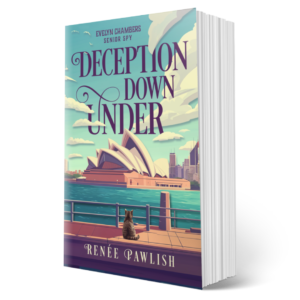
Deception Down Under, Evelyn Chambers Cozy Mysteries: Book 4
Original price was: $19.99.$14.99Current price is: $14.99.Select options This product has multiple variants. The options may be chosen on the product page -
Mug 15oz – Renée Pawlish upright-stacked book banner, Reed & Sarah front
$12.32Select options This product has multiple variants. The options may be chosen on the product page

Reviews
There are no reviews yet.